
Specialist Digital Health Workforce Census
NEWS ALERT:
Due to demand, our partners have requested the Census to remain open.
You can complete the Census through the above link.
About ANZ SPECIALIST DIGITAL HEALTH WORKFORCE CENSUS
The Census project aims to understand the specialist digital health workforce.
It will identify who makes up this workforce and how many people are working in it, explore how the workforce may need to change in the future, highlight gaps or shortages, and map current training and career pathways.
The Census is an online survey conducted every 3 years in Australia and New Zealand by individuals who self-identify as part of the workforce.
Want to hear more - watch our video.
Who is the specialist digital health workforce
Anyone who self‐identifies as being a part of the Specialist Digital Health Workforce. You are part of the workforce if your role (including volunteer or actively seeking) includes a function (listed below) related to health data, information, or knowledge.
Functions could include analysing, coding, designing, developing, educating, evaluating, governing, implementing, maintaining, managing, operating, or researching the data, technology, systems, and services for the health sector..
This may include roles in:
- Biomedical engineering
- Bioinformatics
- Clinical coding
- Clinical documentation improvement
- Digital health leadership
- Entrepreneur or founder
- Epidemiology
- Health artificial intelligence
- Health cyber security
- Health data science/analytics
- Health (allied/clinical/nursing) informatics
- Health information management
- Health information technology
- Health innovation
- Health interoperability
- Health technology investment
- Health librarianship
- Health simulation
- Health technology assessment
- Research and education.
You may undertake more than one role, in which one is a Specialist Digital Health role and the other is not (for example, a clinical or management role). For this Census, only consider the Specialist Digital Health role.
You might not identify as part of the Specialist Digital Health workforce if the primary function of your role is limited to using health data, information, or knowledge but none of the other functions listed above.

SUBSCRIBE TO receive updates and notifications
WHY DOES THE CENSUS MATTER?
The Specialist Digital Health Workforce Census provides the first comprehensive, data‑driven understanding of a workforce that is essential to the safe, effective and future‑ready delivery of healthcare. It matters because it delivers a clear, evidence‑based snapshot of who makes up the specialist digital health workforce, what they do, and where the system is vulnerable, enabling better planning and investment across the health sector.
Importantly, the Census informs government, industry, peak bodies, and education providers by
supplying the data needed to shape education pathways, identify emerging roles, forecast future workforce needs, and ensure Australia can fully realise the benefits of major digital health investments.
In an era where the health system is increasingly dependent on data and technologies to improve safety, equity, quality, and efficiency of care, understanding the specialist workforce that makes this possible is critical. The Census provides that understanding, turning an ill‑defined workforce into a measurable, analysable and strategically actionable asset.
STAY UP TO DATE WITH OUR LATEST SOCIALS
HISTORY
The questions in the Census were developed using a Delphi study design throughout 2017. Experts from several different stakeholder organisations in Australia and New Zealand provided input into the data elements and questions that should be included in the Census.
This was to ensure that the Census would answer the stakeholder group’s questions, and that the questions would not change over time. The Census was then pilot tested by the experts and the executive committees of the partner organisations.
The first Census was conducted in Australia and New Zealand in 2018 under the title the Australian Health Information Workforce Census.
In 2020-21 we validated the data items and piloted the revised census in 2021 under the title the HIDDIN Workforce Census.
The third Census in July 2023 was when we launched the Specialist Digital Health Workforce Census.
INFORMATION ABOUT THE CENSUS
ETHICS & CONSENT
The Census has been approved by the Charles Sturt University Human Research Ethics Committee (H25332). Consent is captured at the start of the Census.

PRIVACY & DATA storage
The Data Management and Access Policy outlines the privacy principles and data management approach.

data access
The Data Management and Access Policy also outlines how to access the Census data.
WHAT HAVE WE LEARNT FROM THE 2023 CENSUS?
870
Australian Specialist DH Professionals Surveyed
41%
Hold Advanced Digital Health Qualifications
56%
Aged 45-64 years
33 hours
Average weekly paid hours
6 years
Average number of years in a role
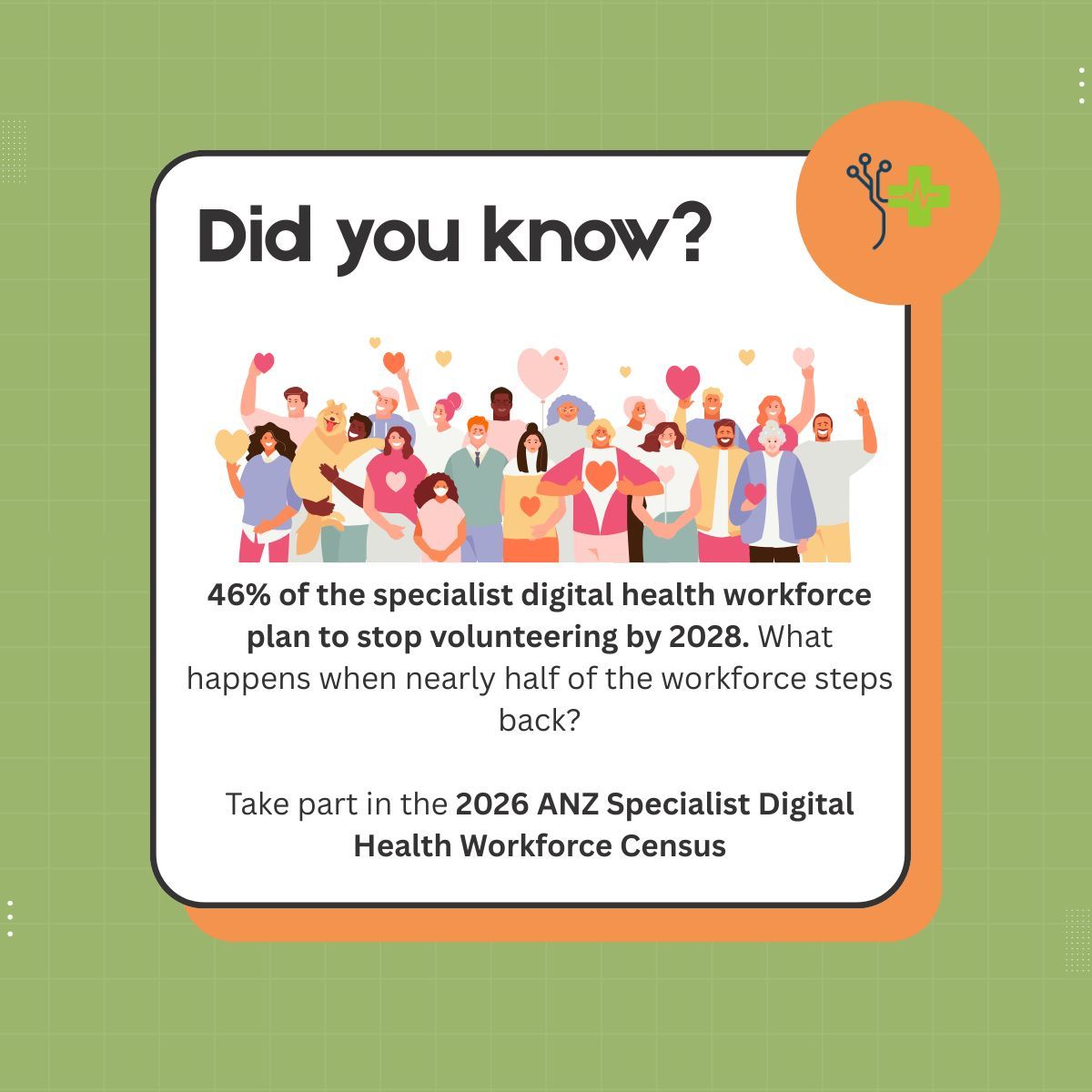
55%
Leave the workforce in the next 10 years
Frequently asked questions
Do you have a question about the Census?
How was the Census developed?
First, a focus group with digital health experts established the structure of the Census in 2016. Next, the Census Delphi Study took place in 2017 to design the Census questions. Experts from a number of different stakeholder organisations in Australia and New Zealand provided input into the data elements and questions that should be included in the Census. The Census was then pilot tested by the experts and the executive committees of the partner organisations.
Who should complete the Census?
Anyone who self‐identifies as being a part of the Specialist Digital Health Workforce can complete the Census. You are part of the workforce if any part of your role (including volunteer or actively seeking) includes a function related to health data, information, or knowledge.
Functions could include analysing, designing, developing, implementing, maintaining, managing, operating, evaluating, or governing the data, technology, systems, and services for the health sector.
I meet the definition of the workforce, but my role is with paper health records. Should I complete the Census?
Absolutely.Whilst the Census refers to the digital health workforce, it is for everyone who works in a role primarily responsible for health data, information, knowledge, and technology.
Should I complete the Census if I use health data and technology but my primary function is patient care
You might not identify as part of the Specialist Digital Health workforce if the primary function of your role is limited to using health data, information, or knowledge but not any of the other functions listed above.
I have more than one role in health.
The Census will allow you to enter information for your primary Specialist role and identify that you have more than one specialist role. Select the role that you spent the most time undertaking in the last week.
If one of your roles is not a Specialist role (e.g. a clinical or management role), only complete the census for your Specialist role.
How will I complete the Census?
On the 1 May, a link will appear above that will take you to the Census. The Census will be open for completion from the 1st May until the 31st May 2026.
You can complete the Census on a computer or mobile device, using any browser. If you would like to complete a paper copy, please email admin@DHWorx.au
The Census consists of a number of select answer and short answer questions relating to your demographic information, educational background, current role, and future professional intentions.
You can choose to provide as much or as little information as you want to share.
How long does it take to complete the Census?
In 2026, we introduced a modified Census that allows you to answer as few or as many questions as you want. The minimal data Census will take less than 5 minutes to complete. The standard Census, where you provide more detailed answers for the main domains in the Census will take 10-15 minutes to complete. And if you elect to answer the additional sections, this will be an additional 5-7 minutes per section.
What are the additional sections?
In 2026, we will have two additional sections:
1. We will have a section asking about your experiences related to equity, diversity, and inclusion.
2. We will also have an additional section about Leadership to enable us to explore the role of the Digital Health Leader.
I started the Census, but changed my mind. What should I do?
Participation in the Census is voluntary. If you have started the Census and changed your mind, please close the browser. Whilst we cannot remove your data because we do not capture any identifyable information, the Census will stop at the point where you closed your browser.
How will you use the data captured in the Census?
We have published multiple papers from our analysis of the Census data. Please visit the Resources and Publications page for examples.
These publications have informed national workforce strategy, including the Australian Digital Health Agency National Digital Health Workforce and Education Roadmap, various jurisdictions, and peak bodies.
How can you call this a census when it does not capture everyone in the workforce?
You are correct, this is a snapshot in time of a representation of the workforce.
We have compared our results against other validated sources and feel confident that we can generalise the results across the Australian and New Zealand workforce.
For example, the Australian Bureau of Statistics conducts the Household Census every four years. It provides a high level report of the Health Information Management occupation and the Clinical Coder occupation. We have compared our data with the ABS data and it is comparable.
We have also undertaken a validation study, which we hope to publish soon.
The Census Project is led by


Supported by the following affiliates:
- University of Auckland
- University of Queensland
- La Trobe University
- Australasian Institute of Digital Health
- Australian Council of Senior Academic Leaders in Digital Health
- ALIA Health Libraries Australia
- Health Information Management Association of Australia